


How the Bohr Effect, the Cardihaler, and Five Minutes a Day Can Restore Balance to Your Nervous System
Most people who come to us complaining of brain fog, sleep problems, or constant exhaustion would never think that their problem is related to breathing. After all, they’re breathing. They’re alive. What could possibly be wrong?
In this episode, I’ll show you why exactly what we learned about breathing in school often does more harm than good in everyday life. And why CO2 breathing training with the Cardihaler—just five minutes a day—can change what no supplement, no exercise, and no meditation app can achieve so directly: your respiratory chemistry.
What to Expect
• Why the idea that oxygen = good and CO2 = waste is physiologically incorrect
• How the Bohr effect works and why CO2 is the key that unlocks the cell door for oxygen
•What happens during brain surgery with controlled hyperventilation—and why the same process occurs on a smaller scale in our daily stressful lives
• How the glymphatic system cleanses your brain and why conscious breathing can stimulate this cleansing throughout the day
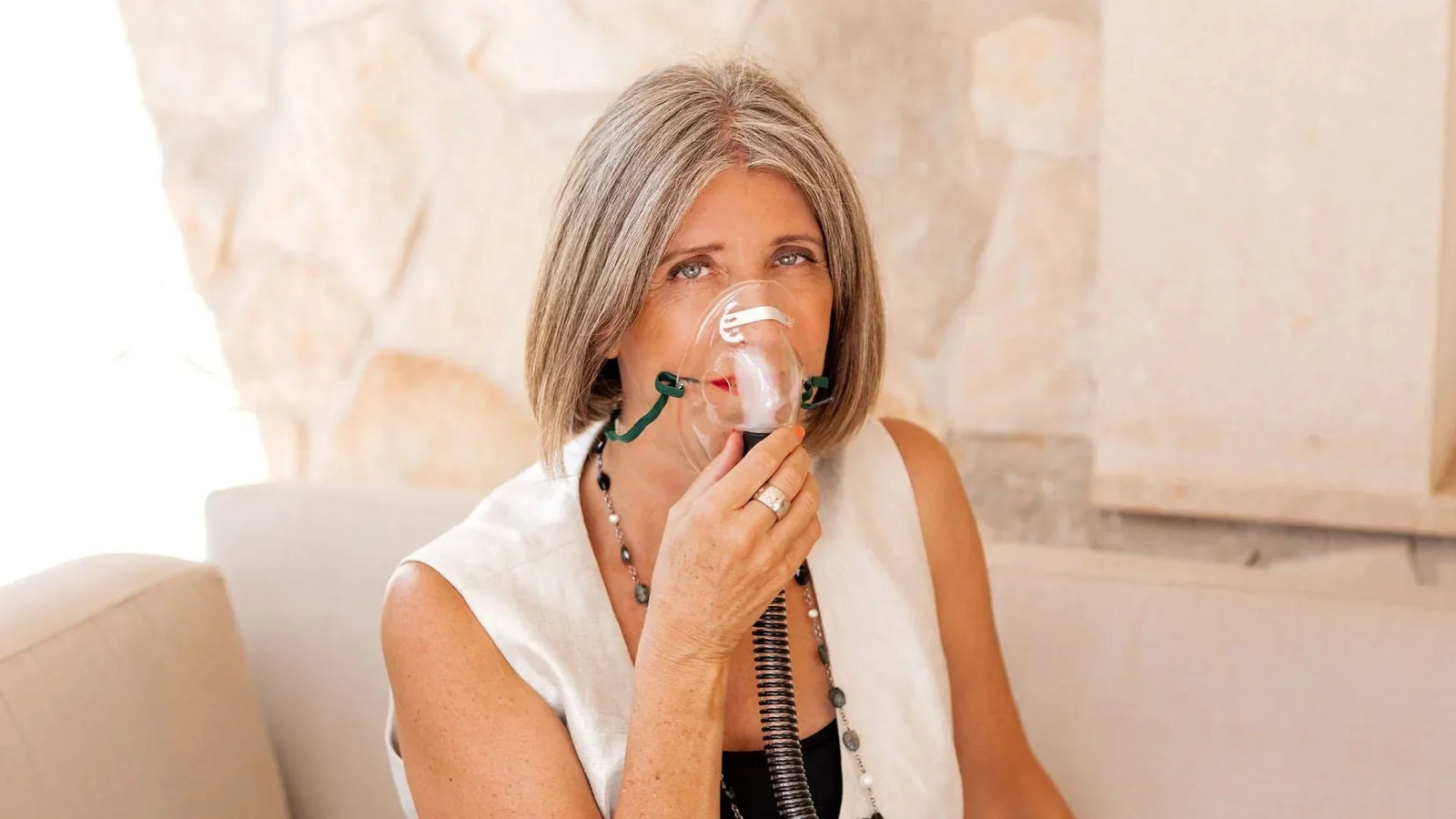
•What the Cardihaler is, how it works, and why five minutes are enough
•Real-life testimonials from the Cardihaler Challenge featuring Claudia Lässer, Pascal Zuberbühler, Chris Fürich, and Dr. Mark Allen
The Textbook Lie: Oxygen and CO2 in the Body
We all learned the same thing in school: We inhale oxygen because we need it to live, and we exhale CO2 because it’s waste. This idea persists, but it’s so incomplete that it’s misleading in practice.
Oxygen activates the system. CO2 relaxes it. Both are necessary. Anyone who chronically breathes too much—that is, moves more air than the body needs at that moment—has too much oxygen in the blood and too little CO2. The result: oxidative stress, inflammation, and poor oxygen supply to the cells.
CO2 is not a waste product. CO2 is a control signal. It regulates how dilated your blood vessels are, how hemoglobin releases oxygen, and how your nervous system switches between tension and relaxation.
The Breathing Reflex: Why You Breathe Is Not Why You Think
When you hold your breath and, after a short time, feel the urge to breathe again, you’re not reacting to a lack of oxygen. Your brainstem detects only the rise in CO2 in your blood. That’s the trigger.
This threshold can be trained. People with a high CO2 tolerance remain calm under pressure. People with a low CO2 tolerance—which is the norm for chronically stressed individuals—breathe quickly and shallowly, often without realizing it. A vicious cycle: Stress leads to shallow breathing, and shallow breathing intensifies the stress.
The Bohr Effect: Why Breathing More Means Less Oxygen
In 1904, Christian Bohr described what is still found in every physiology textbook today: Without CO₂, hemoglobin does not release oxygen into the cells. You can breathe deeply, breathe a lot, or breathe intensely. If your CO2 level is too low, the oxygen gets stuck in the blood and doesn’t reach where it’s needed.
CO2 dilates the blood vessels for better transport. CO2 unlocks the cell door so that oxygen can be released. CO2 protects the mitochondria from excessive oxidative stress.
The Kety Schmidt Effect: When Heavy Breathing Causes the Brain to Shrink
During brain surgery, hyperventilation is used intentionally because low CO2 levels constrict the blood vessels in the brain, causing the brain to physically contract so the surgeon can work. In the stress of everyday life, exactly the same thing happens on a smaller scale. You breathe faster, your CO2 levels drop, and your brain receives less blood. You feel foggy and can no longer think clearly. Not despite breathing more—but because of it.
Conscious breathing activates the brain’s waste removal system
The glymphatic system cleanses the brain of waste products such as beta-amyloids, which are associated with neurological aging. This cleansing process occurs primarily during sleep. What research in recent years has shown is that rhythmically varying CO2 levels through conscious breathing activate similar flow patterns even during the day. Conscious breathing is therefore not just a relaxation technique. It is a form of neurological care.
The Cardihaler: Breathing Training in Five Minutes
Anders Olsson, a Swedish breathing expert, developed the Cardihaler, formerly known as the Carbohaler. The device adds up to eight percent CO2 to the air you breathe in a controlled manner and gently reduces oxygen uptake. The effect: With each use, your body trains itself to tolerate higher CO2 levels. Just as high-altitude training improves oxygen uptake or intermittent fasting resets your metabolism, this is a targeted stimulus to which the body adapts.
No app, no cables, no subscription. A standard CO2 gas cylinder from the supermarket, five minutes a day. That’s all.
What the Cardihaler Challenge Shows
Roman, my co-founder at Arktis BioPharma, left the hospital after just one day following major cervical spine surgery, thanks to intensive use of the Cardihaler before and after the procedure. This led to the Cardihaler Challenge: Twelve prominent figures each test the device for thirty days and then pass it on.
Claudia Lässer, CEO of Blue TV, summed up her experience this way: a very clear head, a quick return to calm—for her, a completely new physical experience. Pascal Zuberbühler, former goalie for the Swiss national team, currently holds the baton.
FAQ
Is CO2 breathing training suitable for everyone?
No. People with severe lung diseases, pregnant women, and individuals with an unstable cardiovascular system or epilepsy should consult their doctor before use. For healthy adults, the method is well tolerated when used properly.
How quickly do you feel the effects?
Most users report a clearer mind and deeper relaxation after just the first session. Structural changes in CO2 tolerance require several weeks of regular practice.
What does breathing have to do with gut health?
Breathing directly controls digestion via the vagus nerve. People who breathe shallowly and rapidly keep the nervous system in sympathetic mode—that is, in a state of stress. In this mode, digestive functions are suppressed. Conscious abdominal breathing activates the parasympathetic nervous system and, with it, digestion. In addition, deep breathing causes the diaphragm to mechanically massage the abdominal organs and supports lymphatic flow.
Can I train my CO2 tolerance without a device?
Yes. Classic breathing methods such as Buteyko, Wim Hof, or simply breathing through the nose with prolonged exhalation also train CO2 tolerance. The advantage of the Cardihaler: it’s faster, measurable, and significantly less time-consuming. The disadvantage: the initial cost.
As a podcast listener, you’ll receive a discount on our products
Specifically, a 15% discount on your first purchase (valid once, only on products not already discounted). The coupon code is valid at both Arktis BioPharma stores in Switzerland and Germany.
To redeem it,
enter the coupon code podcast15 before completing your order.
Arktis BioPharma Store Switzerland
Arktis BioPharma Store Germany