

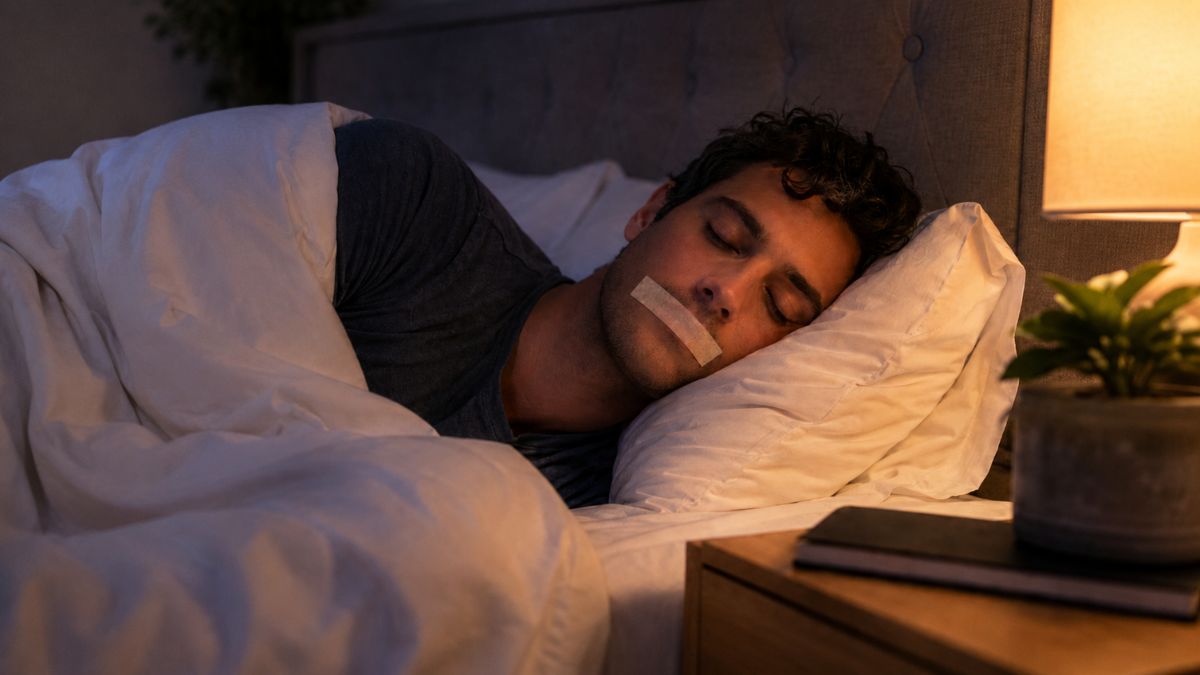

Our nose is a remarkably well-equipped organ. It filters dust and particles from the air we breathe, moistens it, and brings it to body temperature before it reaches the lungs. On top of that, there’s a detail that hardly anyone knows: our sinuses constantly produce nitric oxide, a signaling molecule that travels downward with the inhaled air, where it has vasodilatory and antimicrobial effects. However, when we breathe through our mouths—especially at night—this entire process is bypassed. The air enters cold, dry, and unfiltered.
Anyone who is deeply involved in optimizing their own sleep or athletic recovery is increasingly coming across a simple yet effective approach: mouth taping. In this article, we objectively analyze the effects of gently closing the mouth on snoring, jaw tension, and muscle recovery.
What can you do about snoring when mouth breathing disrupts your sleep?
Mouth breathing and snoring are closely intertwined. After all, for most people, snoring is what brings the topic of nasal breathing to the forefront. Yet snoring itself is by no means merely an acoustic problem; rather, it is often the result of collapsing airways or an abnormal tongue position. Many people affected by this wonder if there’s anything they can do about snoring at all. From a physiological perspective, breathing exclusively through the nose offers significant benefits for airway stability. Gently closing the mouth can help restore natural breathing patterns during sleep. We’ll start by taking this holistic view and then delve into the specific details.
A quick overview: The causes of snoring
Nighttime snoring occurs when inhaled air causes soft tissues in the relaxed throat—primarily the soft palate and uvula—to vibrate. Breathing through the mouth further exacerbates this, as the lower jaw drops backward, narrowing the airway. A closed mouth and an unobstructed nose are therefore the most obvious starting points—and they’re also the simplest.
What helps with snoring?
At first glance, the common question “What helps with snoring?” naturally seems complex. Yet it can be answered in a surprisingly concrete way. That’s because there are clear levers you can directly adjust, and these five measures have proven effective:
- Strengthen the muscles in the mouth and throat
- The tongue, soft palate, and throat are made up of muscles, and muscles can be strengthened. A more stable airway vibrates less. This is the most thoroughly researched approach to snoring and, at the same time, the one you have the most control over.
- Ensure nasal breathing
- A clear nose reduces breathing resistance, the airflow becomes smoother, and the soft tissues in the throat vibrate less.
- Cut Back on Evening Alcohol
- Alcohol relaxes the throat muscles. However, while this may provide some relaxation during the day, at night it causes the airways to collapse more easily, making nighttime snoring louder.
- Lose weight if you’re significantly overweight
- Relieving pressure on the airways is worthwhile, as fatty tissue in the neck area constricts the airway from the outside.
- Adjust your sleeping position
- When sleeping on your back, the tongue naturally sinks backward due to gravity. Sleeping on your side, however, prevents the tongue from falling back into the throat and allows for easier airflow.
In addition to weight loss, avoiding alcohol in the evening, and maintaining an optimal sleeping position, a clear airway also plays a central role. Consistent nasal breathing increases slight respiratory resistance, which can lead to deeper and more even diaphragmatic breathing. This helps stabilize the breathing rhythm and also minimizes the collapse of the throat.
What to Do About Snoring Caused by High Physical Strain or Stress?
A question that is both relevant and frequently asked online is: “What should you do about snoring during periods of increased physical exertion, such as during intense training phases or stressful life events?” And this question is entirely understandable, because a high training load or increased stress levels, in particular, often lead to a slightly swollen nasal mucosa and shallower, faster breathing. The key here is to gently reacclimate the body to nasal breathing without creating unnecessary pressure. Breathing exercises that focus on prolonged exhalation and keeping the air in your room well-humidified provide the best foundation during such periods.
Improving Your Nasal Breathing Without Surgery
The following insight may come as a surprise, but to improve your nasal breathing, surgery on the turbinates isn’t necessarily required. In many cases, a stuffy nose is the result of overventilation, because the more air that flows through the mouth, the more the nasal mucous membranes swell as a protective reaction. And as soon as you consistently breathe through your nose again and your body’s CO₂ tolerance increases, the nasal passages often open up on their own.
Breathing exercises that reduce breathing volume and gradually increase CO₂ tolerance have proven particularly effective. Almost anyone can improve their nasal breathing this way without having to worry about surgery or lengthy recovery processes.
Please note, however:
If your nose remains permanently blocked, an ENT examination will clarify whether there are anatomical obstacles such as a deviated nasal septum, medical causes such as polyps or other inflammations, or narrow passages.
Breaking the Habit of Mouth Breathing: How to Make the Transition Easier During the Day
If you want to break the habit of mouth breathing, you’re essentially working on changing a habit. Since this is a deeply ingrained movement pattern in our bodies, it takes some patience to break the habit of mouth breathing. Especially because habits are best changed when you can consciously control them—namely, during the day. So your transition doesn’t start in bed, but actually in the midst of your daily life—at work, during exercise, or even while relaxing.
5 great strategies you can combine to break the habit of mouth breathing:
- Practice Mindfulness During the Day
- Check regularly throughout the day to make sure your lips are closed and your tongue is resting against the roof of your mouth.
- Establish fixed routines for light exercise while breathing through your nose
- Try doing this while commuting, going for a walk, cooking, cycling at a slow pace, or even at your desk
- 3 times a day
- 10 minutes
- Try doing this while commuting, going for a walk, cooking, cycling at a slow pace, or even at your desk
Our support for your routine:
We’ve elegantly designed a tool that takes the counting out of your routines: our Relaxator. This handy little tool features adjustable exhalation resistance for a calm exhalation and also naturally prolongs the exhalation.
10–15 minutes, 1–2 times a day, is enough to allow your breathing rhythm to relax.
- Extend the exhalation
- Breathe in through your nose for
- 4 seconds, and
- 6–8 seconds
- This lowers your breathing rate and naturally makes nasal breathing more comfortable.
- Breathe in through your nose for
- During exercise
- Especially during low-intensity workouts, it’s recommended to breathe consistently through your nose.
- Mouth Taping at Night
- For mouth taping, you can use a special sleep tape that effortlessly helps you breathe through your nose while you sleep.
But more on that in a moment...
The great thing is that your body usually goes along with this process very willingly, since nasal breathing is the default mode it’s naturally designed for. So it’s less about learning something new and more about reclaiming a skill you’ve forgotten. And just how formative this breathing pattern is becomes particularly clear in children, because years of mouth breathing can even alter the shape of their jaw and face. In adults, the changes are less visible, but the underlying effect remains the same.
Mouth Taping to Relax the Jaw Muscles & Masticatory System
Once nasal breathing is established during the day, mouth taping is the logical next step. It takes over at night the role that your attention fulfills during the day, keeping your mouth loosely closed even while you sleep and allowing air to flow where it is filtered, moistened, and warmed.
At the same time, chronic tension in the facial area is often an overlooked side effect of nighttime mouth breathing. This is because when the mouth is left open at night, the jaw muscles unconsciously try to hold the lower jaw in place against gravity. So anyone who breathes through their mouth at night often also has a tense jaw and tends to clench or grind their teeth. Both issues stem from the same basic posture—namely, the position of the lips and tongue. Using mouth taping to relax the jaw muscles can provide simple relief in this regard.
How does mouth taping work?
Mouth taping focuses on gently correcting breathing patterns. Using an elastic skin tape, the lips are gently secured, the lower jaw remains stable, and the tongue is automatically pressed against the upper palate. This keeps the upper airways open and reduces vibrations of the soft palate.
How mouth taping can promote relaxation of the jaw muscles at night
It’s best to incorporate mouth taping into your daily evening routine without any pressure. While the physical adjustment to nighttime nasal breathing takes some time, it can be done gradually and gently. With the right techniques, however, your body can easily get used to the new routine. Here’s an overview of the most important tips for a relaxed application:
- Feel free to take it slow
- Start by wearing the tape for 5–10 minutes in the evening while reading or relaxing before going to sleep.
- For sensitive skin
- If you have sensitive skin, you can easily reduce the tape’s stickiness by briefly pressing the strip against a piece of cloth a few times beforehand.
- Alternatively, cut the strip in half and gently apply it vertically from your nose to your chin—this way, less of the strip comes into contact with your skin.
- The morning after using it overnight
- In the morning, briefly moisten your lips with your tongue and peel the tape off from the inside instead of pulling it straight off.
Our hypoallergenic & gentle Sleep Tape:
To ensure this method is gentle on your skin, our gentle Sleep Tape—a pack of 90 sleep patches (mouth tape for nasal breathing while sleeping)—is made of rayon, is hypoallergenic, and is completely free of latex and rosin. Available in a convenient 1-month pack, it can help you establish a consistently restful sleep routine.
Maintaining this mouth position regularly helps relax both the chewing muscles and the temporomandibular joint. Because the tongue rests gently against the roof of the mouth, it also acts as a natural spacer for the upper jaw, thereby relieving pressure on the airways and the surrounding muscles. Studies on tissue oxygenation, including research from the University of Lübeck, also show that a balanced CO₂ concentration in the blood dilates blood vessels, which is why this form of relaxation allows the temporomandibular joint and masticatory muscles to be better supplied with oxygen. And this ultimately allows the entire shoulder and head area to relax.
Nasal Breathing & Mouth Taping in Everyday Sports
You can also specifically practice nasal breathing during training. This works best during calm, basic training sessions where you’d be able to breathe through your nose easily anyway. Gentle mouth taping serves as a reminder during these sessions and can help you reinforce this natural breathing pattern. As intensity increases, the body automatically switches to mouth breathing anyway, because the nose limits airflow—and this is a sensible adaptation, not a mistake. For intense workouts, interval training, and competitions, the rule is: no tape. And if your breathing feels restricted at any point, just take the tape off.
Tip: By the way, you can learn how strained muscles and rapid recovery after exercise are connected in our blog post “Muscle Soreness: What Happens in the Muscle & What Really Helps.”
Targeted Recovery of the Jaw Muscles
In fact, the recovery of the muscles in the jaw follows the same principles as everywhere else in the body, as it requires rest, blood flow, and sleep. The difference lies simply in the fact that the masticatory muscles are rarely consciously strained, since chronic tension there often goes unnoticed for a long time.
The most effective approach is therefore to train the muscles so that lip closure and tongue position function automatically. This is precisely the goal of so-called myofunctional training—that is, targeted muscle training of the mouth and face. Our FaceFormer, for example, works according to this principle and can be easily combined with our Sleep Tape. During the day, the FaceFormer trains your breathing and closure patterns, and the tape supports you throughout the night.
Another factor that makes the transition easier for many people is CO₂ tolerance. Those who breathe quickly and shallowly may initially find nasal breathing rather constricting, because even a slight increase in carbon dioxide in the blood is perceived as a lack of air. With a little practice, however, this threshold shifts. The CardiHaler from Gruber CO₂-Systems supports you exactly here by letting you start your training gently with 1–2 minutes at a low setting.
Conclusion: Mouth taping can improve your sleep and daily life
The nose does more than most people give it credit for. It filters, humidifies, and warms the air, and also delivers signaling molecules from the sinuses. If you want to reclaim this natural way of breathing, start with the simple things during the day: First, clear your nose; set aside conscious breathing moments in your daily routine; gently lengthen your exhalation; and, ideally, practice proper tongue positioning and a gentle lip seal.
At night, mouth taping acts as a gentle guide to remind the body of its natural breathing path. By consistently switching to nasal breathing, you’ll generally improve not only your sleep quality and reduce your tendency to snore—in the best-case scenario—but also your overall oxygen supply to the tissues, including relaxation of the masticatory muscles and recovery after exercise. Those who also wish to relax their temporomandibular joint should pay additional attention to everyday triggers, such as avoiding screen time with the head tilted forward, periods of stress, or prolonged chewing of gum. For chronic symptoms, a dental or medical evaluation is also recommended to identify any organic or functional imbalances.
After all, when you provide your body with the right conditions at night, it regenerates more effectively and you start the day with more energy. Just give your body some time to adjust and find your way back to your natural breathing rhythm at your own pace.
You can find more posts on this topic in our blog section “Improving Nasal Breathing.”
FAQ: Common Questions About Mouth Taping & Nasal Breathing
What helps with poor nasal breathing?
If you have poor nasal breathing, the first step is to identify the cause. The most common causes include airway irritation from allergies, enlarged turbinates, adenoids, a deviated nasal septum, or the prolonged use of decongestant nasal sprays. Nasal rinses with saline solution, consistent allergy treatment, adequate humidity in the bedroom, and mechanical nasal dilators have proven effective in practice. If your nose remains constantly blocked, you should consult an ENT specialist.
How can I improve my nasal breathing?
Nasal breathing improves primarily through daily practice. Consciously breathe only through your nose for ten minutes several times a day, prolong your exhalation, and consistently focus on nasal breathing during low-intensity exercise sessions. Nighttime aids like our Sleep Tape are excellent for supporting this process as part of mouth taping.
How can I train myself to breathe through my nose?
Nasal breathing can be trained like any habit. A proven method is a rhythm of four seconds of inhalation and 6–8 seconds of exhalation for five minutes, 1–2 times a day. It’s also helpful to incorporate fixed routines into your daily schedule, such as your commute or a walk. Similarly, using training devices with exhalation resistance, such as the Relaxator, can be beneficial, as this stimulus helps the body adjust its CO₂ tolerance.
Why do I have trouble breathing through my nose?
The most common causes are swelling of the nasal mucosa due to allergies or an infection, enlarged turbinates, nasal polyps, and a deviated nasal septum. Occasionally, however, the blockage is simply the result of chronic mouth breathing. Due to the constant flow of air through the mouth, the turbinates swell as a compensatory response. In most cases, however, nasal patency can be restored through targeted nasal breathing exercises. If, however, the difficulty breathing persists for weeks or occurs on only one side, it should be evaluated by a doctor.